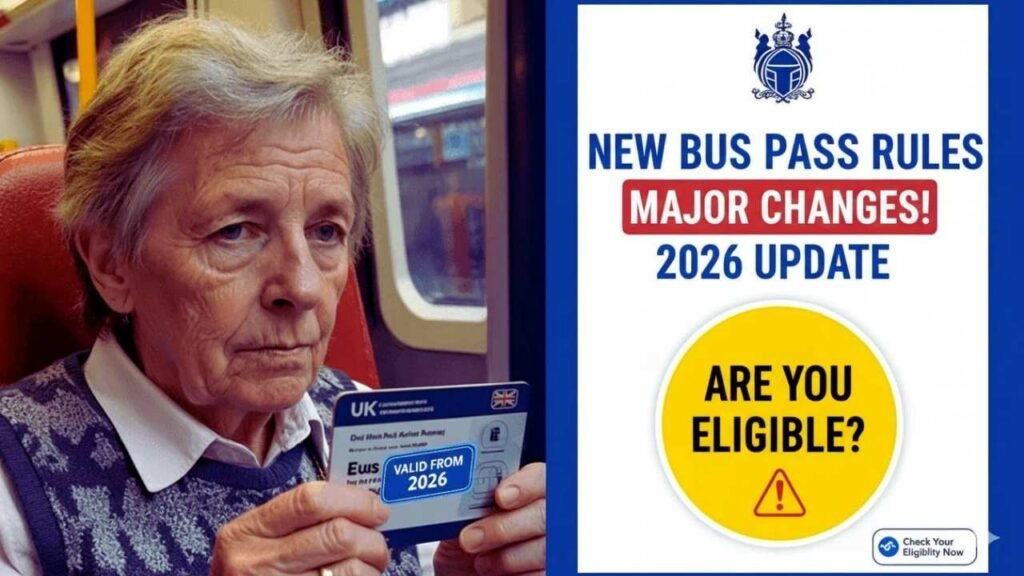
The UK government has today provided a major update on the future of concessionary travel, clarifying how the free bus pass system will evolve for those approaching their 60s. This announcement aims to address long-standing questions regarding regional disparities and the impact of the rising retirement age.
Alignment with State Pension Age in England
One of the most significant confirmations from the Department for Transport today is that the eligibility for a free bus pass in England will remain strictly tied to the State Pension age. As the State Pension age is scheduled to rise from 66 to 67 between 2026 and 2028, the age at which residents can claim their travel pass will move in lockstep.
This means that many individuals who expected to receive their pass upon turning 66 will now have to wait until their 67th birthday. The government defended this link, citing the need for the English National Concessionary Travel Scheme (ENCTS) to remain financially sustainable as life expectancy trends change over the long term.
Regional Variations Across the UK
While English residents must wait until they reach the official pension age, the government confirmed that the “over-60s” eligibility remains a reality in other parts of the United Kingdom. Because transport policy is a devolved matter, Scotland, Wales, and Northern Ireland will continue to offer free bus travel to everyone once they turn 60.
- Scotland: Free travel for all residents aged 60 and over.
- Wales: Concessionary passes available at age 60.
- Northern Ireland: SmartPass eligibility begins at age 60.
- England: Eligibility tied to State Pension age (currently 66, rising to 67).
This confirmation highlights a growing gap between England and its neighbors. Despite a parliamentary petition gaining over 100,000 signatures to lower the English age to 60, the government has stated it has no current plans to change the statutory age requirement at a national level.
Local Council Powers and Discretionary Funding
Despite the national age limit, the government today reminded local authorities that they possess the legal power to offer more generous concessions if they choose to fund them locally. Several regions have already taken advantage of this to support their older populations before they hit the official pension age.
For example, residents in London can still access a 60+ Oyster photocard, which provides free travel on buses and tubes within the capital. Similarly, authorities in Merseyside and Greater Manchester have previously implemented local schemes that offer additional benefits beyond the national statutory requirements.
- Local councils can lower the age of eligibility using their own budgets.
- Authorities may choose to allow travel before the standard 9:30 am start time.
- Some regions provide free travel on trams and local trains alongside buses.
Future Transitions and Implementation
For those born between March 1961 and April 1977, the transition to the new age-67 threshold will be a gradual process. The government has released updated guidance for these “transition groups” to help them calculate exactly when they will become eligible for both their pension and their bus pass.
The official start of the next phase of age increases is set for April 2026. Officials have urged anyone approaching their mid-60s to check their specific eligibility date online, as the exact day you qualify depends on your month and year of birth rather than just your 66th or 67th birthday.
Maintaining Lifeline Services
In today’s statement, the Department for Transport emphasized that the bus pass remains an “absolute lifeline” for millions of older people. Even with the age increases, the government remains committed to funding the existing scheme, which costs approximately £795 million annually in England alone.
By maintaining the link to the pension age, the government argues it can protect the core benefit—free off-peak travel across the country—for the long term. This ensures that once a person does qualify, they can continue to access essential services, healthcare, and social connections without the burden of transport costs.
Frequently Asked Questions
Can I use my bus pass before 9:30 am?
The national statutory scheme covers off-peak travel, which is generally from 9:30 am to 11:00 pm on weekdays and all day on weekends. However, some local councils allow earlier travel, so you should check with your specific local authority.
What happens if I already have a bus pass?
If you already possess a valid concessionary bus pass, today’s announcement does not take it away. Your current pass remains valid until its expiry date, at which point you will simply follow the standard renewal process.
Do I have to be retired to get the bus pass?
No, eligibility is based solely on your age. Even if you are still working full-time or part-time, you are entitled to the free bus pass as soon as you reach the qualifying State Pension age.
Why is it 60 in Scotland but 66 in England?
Transport is a devolved issue, meaning the governments in Scotland, Wales, and Northern Ireland decide their own rules and budgets for bus passes. The UK government only sets the rules for the national scheme in England.
How do I apply for a pass when I reach the right age?
Applications are usually handled by your local council or transport authority. You will typically need to provide proof of age, such as a birth certificate or passport, and proof of your current address.
Last updated: 11 Mar 2026 (UK Time)