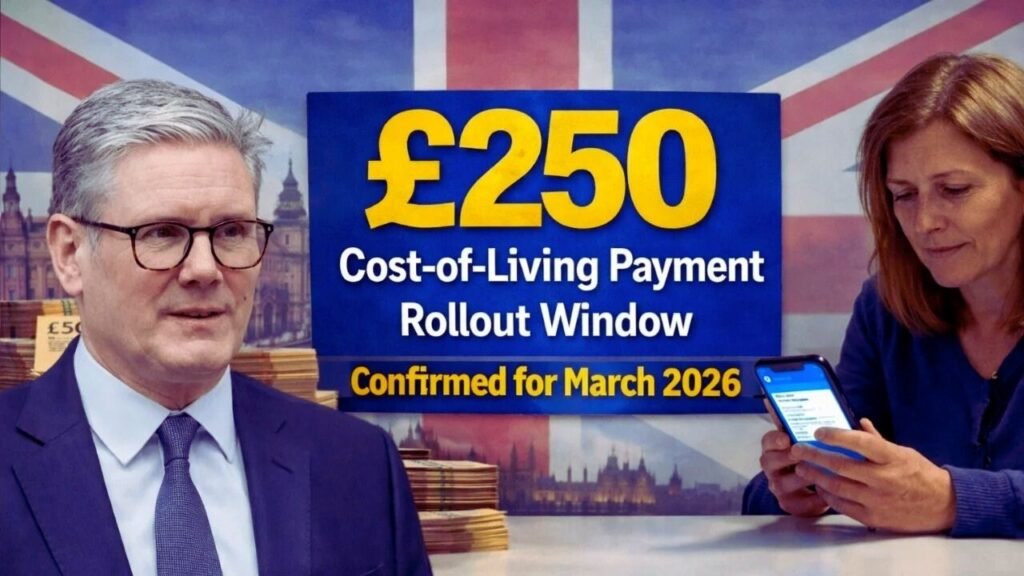
The UK government has officially confirmed the rollout window for a new £250 cost-of-living payment, providing a targeted financial boost to millions of households. This one-off payment is designed to help low-income families and vulnerable individuals manage essential costs as the winter season transitions into spring.
Eligibility Criteria for the March Payment
The Department for Work and Pensions (DWP) has outlined specific criteria to ensure the support reaches those most in need. To qualify for the £250 payment, individuals must have been in receipt of certain means-tested benefits during a designated qualifying period earlier this year. This approach mirrors previous support schemes but with updated parameters to reflect the 2026 economic landscape.
- Recipients of Universal Credit and Pension Credit
- Individuals on income-based Jobseeker’s Allowance (JSA)
- Families receiving tax credits with a valid award
- Claimants of income-related Employment and Support Allowance (ESA)
Government officials have stressed that the payment is intended to be a safety net for households who are not already seeing significant gains from the upcoming April benefit uplifts. By delivering the funds in March, the goal is to provide a “bridge” of support before the new financial year begins.
Key Dates and the Rollout Window
The official rollout is scheduled to begin on March 16, 2026, and will continue through the end of the month. Most eligible households can expect to see the funds in their bank accounts within the first ten days of the window. The payment will be made automatically, meaning there is no need for residents to apply or contact the DWP to trigger the transaction.
It is important to note that the payment will appear on bank statements as a distinct entry, separate from regular benefit installments. While the vast majority of payments will be completed by March 31, a small number of complex cases—such as those involving recent appeals or changed bank details—may see their funds arrive in early April.
Integration with Local Support Funds
This national rollout coincides with the final phase of the 2026 Household Support Fund, which is also administered through local councils. While the £250 payment is a fixed national amount, residents are encouraged to check with their local authorities for additional discretionary help that may be available simultaneously.
- Local councils can provide vouchers for food and energy bills
- Emergency grants may be available for essential household appliances
- Specialized support is often reserved for those who narrowly miss national eligibility
- Funding through local schemes is available until the March 31 deadline
The government’s strategy for March 2026 focuses on a “multi-layered” approach. By combining the direct £250 cash injection with local discretionary funding, the Department for Work and Pensions aims to cover a broader range of financial pressures, from rising grocery bills to unexpected home repairs.
Impact on Future Benefit Changes
The timing of this payment is strategic, arriving just weeks before the wider 4.8% increase in the State Pension and the 6.2% boost to Universal Credit standard allowances. Because this £250 sum is classified as a “cost-of-living grant,” it is completely tax-free and will not count toward the benefit cap or affect existing entitlement levels.
For many households, this March payment represents a final piece of emergency fiscal support before the government moves toward a more permanent structure of increased monthly benefits in April. This shift marks a transition away from ad-hoc lump sums toward a more predictable, inflation-linked social security system.
Staying Safe from Payment Scams
With any high-profile government rollout, there is an increased risk of fraudulent activity. The DWP has issued a firm reminder that they will never send text messages or emails asking for personal bank details or “application fees” to release the £250 payment.
Since the process is entirely automatic, any communication claiming you need to “register” or “click a link” to receive the money is a scam. If the funds do not arrive by the end of the March window and you believe you are eligible, the official advice is to wait for the dedicated online reporting portal to open in early April rather than responding to unsolicited messages.
Last updated: 11 Mar 2026 (UK Time)